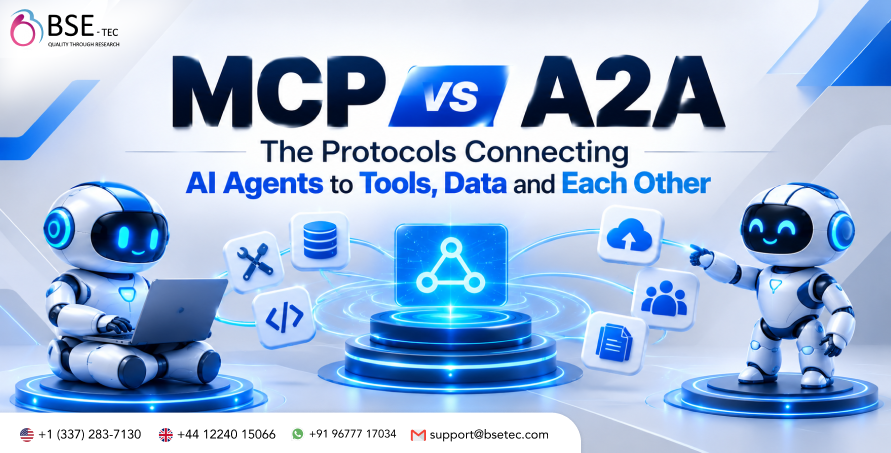
MCP vs A2A is an important comparison for businesses exploring AI agents in 2026. AI agents can now do more than answer questions. They can retrieve information, use external tools, complete tasks, and collaborate with other agents. However, these capabilities require reliable ways to connect AI systems with the tools, data, and services they need.
That is where the Model Context Protocol (MCP) and Agent2Agent (A2A) Protocol come in. MCP helps AI applications connect with tools and data, while A2A helps independent AI agents communicate and collaborate. Together, they create new possibilities for building connected AI workflows.
At BSEtec, developing AI-powered and blockchain-based solutions requires an understanding of how modern technologies work together. As businesses explore intelligent automation, protocols such as MCP and A2A can help developers design systems that connect different capabilities instead of relying on isolated AI applications.
What Is MCP?
The Model Context Protocol (MCP) provides a standard way for AI applications to connect with external tools, data sources, and services. Instead of building a separate integration for every AI application, developers can use MCP to create more consistent connections.
Think of MCP as a universal connector for AI applications. For example, an AI assistant may need to search company documents, retrieve information from a database, or interact with an external API. With suitable MCP integrations, the assistant can access those capabilities through a common protocol.
MCP servers can expose three main types of capabilities:
- Tools: Functions that an AI application can call to perform actions, such as searching a database or accessing an API.
- Resources: Information that an application can retrieve, such as documents, records, or other contextual data.
- Prompts: Reusable templates that help structure interactions with AI models.
As a result, developers can connect AI applications to multiple services without creating every integration from scratch. Moreover, they can reuse compatible integrations across supported AI clients.
For businesses, this approach can simplify development and make it easier to expand an AI application’s capabilities as requirements change.
What Is the A2A Protocol?
The Agent2Agent (A2A) Protocol focuses on a different challenge: enabling independent AI agents to communicate and collaborate.
Imagine a business that uses separate agents for customer support, inventory management, order processing, and delivery planning. Each agent may specialize in a particular task. However, the business gains more value when these agents can coordinate their work instead of operating independently.
A2A provides a common communication standard for this type of collaboration. It helps agents discover other agents, understand their capabilities, delegate tasks, and exchange results.
For example, a customer-support agent might receive a request about a delayed order. It could coordinate with an order-management agent to check the order status and a delivery agent to retrieve shipping information. The support agent could then use the results to prepare a response.
Consequently, businesses can connect specialized agents even when different teams build them with different frameworks or technologies. A2A focuses on communication between agents rather than replacing the tools each agent uses internally.
MCP vs A2A: What Is the Difference?
Although MCP and A2A both support connected AI systems, they solve different problems. MCP connects AI applications with tools and data, whereas A2A connects independent agents with one another.
| Feature | MCP | A2A |
| Main purpose | Connect AI applications to tools and data | Enable communication between AI agents |
| Connects | AI applications, tools, resources, and services | Independent AI agents |
| Common use | Database queries, API calls, document access | Delegating tasks and coordinating agent workflows |
| Key benefit | Reusable tool and data integrations | Collaboration across different agents |
| Example | An agent retrieves customer details from a database | A support agent asks another agent to check delivery status |
Therefore, developers should not treat MCP and A2A as competing technologies. Instead, they can use both protocols to support different parts of the same AI system.
MCP gives an agent access to the capabilities it needs. Meanwhile, A2A allows that agent to work with other agents when a task requires additional expertise.
How MCP and A2A Work Together
The real value appears when developers combine both protocols in one workflow.
Consider an e-commerce company that wants to automate order support. The company could create a support agent that communicates with specialist agents through A2A. Each specialist agent could then use MCP to access the tools and information required for its own tasks.
Here is how the process might work:
- A customer asks the support agent about a delayed order.
- The support agent contacts an order-management agent through A2A.
- The order-management agent uses an MCP connection to retrieve the order details.
- Next, the support agent contacts a delivery agent through A2A.
- The delivery agent uses its available tools to retrieve the latest shipping information.
- Finally, the support agent combines the results and responds to the customer.
In this example, A2A manages communication between agents, while MCP helps those agents access external capabilities.
Furthermore, developers can add new agents or integrations as business needs grow. A company might introduce a refund agent, for instance, without redesigning the entire workflow. However, the team must still define clear responsibilities, access permissions, and approval rules.
Where Can Businesses Use MCP and A2A?
MCP and A2A can support different business applications. Their value depends on the tasks an organization wants to automate and the systems it needs to connect.
1. Customer Support Automation
Customer-support agents often need information from order systems, customer databases, product documentation, and delivery services.
MCP can connect an agent to these resources. Meanwhile, A2A can help the support agent coordinate with specialist agents for refunds, technical issues, or delivery updates.
As a result, businesses can create more connected support workflows instead of relying on a single assistant to handle every task.
2. Business Operations
Companies often manage separate systems for sales, finance, inventory, and logistics. AI agents can help teams retrieve information and coordinate routine tasks across these departments.
For example, an inventory agent could check product availability through its connected tools. At the same time, a purchasing agent could evaluate stock requirements and coordinate the next steps through A2A.
Nevertheless, businesses should apply appropriate approval rules before agents perform sensitive actions, such as issuing payments or changing important records.
3. Software Development
Development teams can use AI agents for code analysis, testing, documentation, and issue tracking. MCP can connect supported AI applications to development tools and repositories, while A2A can help specialist agents coordinate work.
For instance, a code-review agent could identify a potential problem and ask a testing agent to investigate it. Subsequently, a documentation agent could update the relevant technical notes after the team approves the change.
This approach can help teams organize complex workflows. However, developers must still review important code changes and maintain suitable security controls.
4. Enterprise Data Access
Businesses often store information across databases, internal documents, and external services. MCP can provide a consistent way for AI applications to access supported data sources.
Additionally, A2A can help different agents collaborate when a task requires information from multiple business functions. For example, a reporting agent could coordinate with sales and inventory agents to gather the information needed for a business summary.
Therefore, organizations can explore more flexible AI workflows while keeping each agent focused on a defined responsibility.
Security and Implementation Challenges
Although MCP and A2A can simplify connectivity, protocols alone do not make an AI system secure. Developers must consider how agents access information, which actions they can perform, and how they handle unexpected results.
First, teams should apply least-privilege access, giving each agent only the permissions it needs. For example, a reporting agent may need permission to read sales data but should not automatically receive permission to modify financial records.
Moreover, developers should authenticate connected services, protect sensitive credentials, and validate inputs and outputs. They should also monitor agent activity to identify unusual requests or unexpected behavior.
Another important consideration is human approval. Although an agent may retrieve information automatically, sensitive actions such as transferring funds, deleting records, or approving transactions may require explicit authorization.
Finally, teams should test the complete workflow rather than checking each integration separately. An individual agent may work correctly, yet the combined system could still produce incorrect results if agents misunderstand instructions or pass incomplete information.
Consequently, a successful implementation needs clear workflows, suitable security controls, reliable error handling, and ongoing monitoring.
How BSEtec Helps Businesses Build Connected AI Solutions
At BSEtec, businesses can explore AI and blockchain solutions that connect intelligent agents, business applications, and digital infrastructure. Its services include AI Agent Development, Custom Multi-Agent Platforms, AI Workflow Automation, API Integration, and AI-Enhanced Application Development. These capabilities can help businesses design AI workflows that connect tools, access relevant data, and coordinate tasks across different systems.
Furthermore, BSEtec provides smart contract development, blockchain integration, Web3 solutions, and AI-powered blockchain applications for businesses exploring connected digital platforms. Depending on project requirements, MCP can support connections between AI applications and external tools, while A2A can help independent agents coordinate tasks. By combining the right technologies, businesses can explore more flexible automation workflows with suitable access controls and security measures.
Explore BSEtec’s AI solutions and blockchain development services to discover options for building connected AI and blockchain applications.
For example, a business could explore AI agents to coordinate routine tasks while connecting them to approved data sources and existing applications. Meanwhile, developers can define the permissions, testing procedures, and monitoring processes needed to support reliable operation.
MCP and A2A offer useful building blocks for these designs. However, the right architecture depends on the business problem, the systems involved, and the level of automation required.
Explore BSEtec to learn more about its blockchain development capabilities and technology solutions for business needs.
Conclusion
MCP and A2A address two important challenges in AI development. MCP helps AI applications connect with tools and data, while A2A enables independent agents to communicate, delegate tasks, and collaborate.
Together, these protocols can support connected AI workflows across customer support, business operations, software development, and enterprise data access. However, businesses must also consider permissions, security, testing, and human oversight when implementing these systems.
As AI applications become more connected, developers need to think beyond individual models and focus on how complete systems work together. BSEtec can help businesses explore blockchain development and connected technology solutions based on their requirements, creating opportunities to combine emerging technologies with practical business goals.