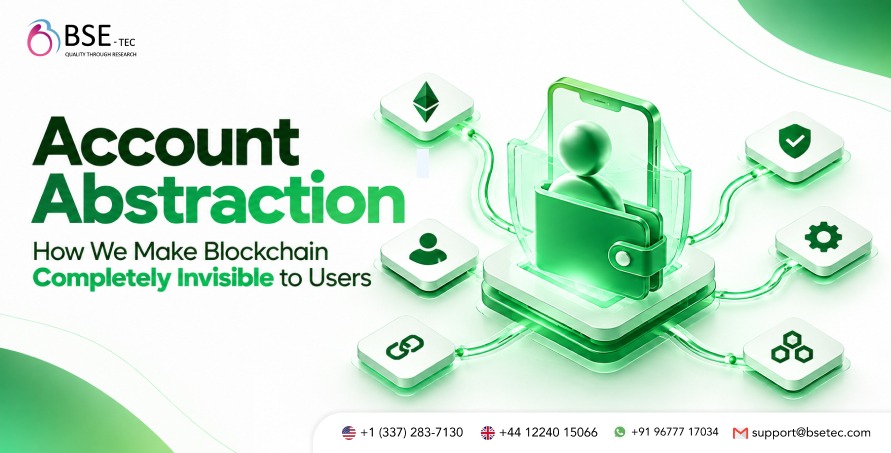
Imagine opening a Web3 app and never seeing a seed phrase, never worrying about gas, and never approving five separate transactions just to complete one simple action. That is the promise of Account Abstraction.
For years, blockchain adoption has been slowed by technical steps that ordinary users should never have to understand. Wallet addresses, private keys, gas fees, network switching, and transaction approvals can make even simple blockchain applications feel complicated.
Account Abstraction changes that experience by turning wallets into programmable smart accounts.
For businesses building Web3 applications, this creates an opportunity to make blockchain feel less like blockchain and more like a normal digital product.
BSEtec is working at this intersection of blockchain development, smart accounts, AI, and Web3 infrastructure, helping businesses build applications where complex blockchain operations can happen behind a much simpler user experience.
What Is Account Abstraction?
Account Abstraction is a blockchain architecture that separates the user’s account experience from the traditional private-key-based transaction model.
In simple terms, instead of forcing users to manage every technical blockchain requirement, the wallet can include programmable rules.
Ethereum currently supports two important approaches around this idea: ERC-4337 and EIP-7702. ERC-4337 introduced a higher-layer system using UserOperations, bundlers, EntryPoint contracts, and Paymasters, while EIP-7702 offers another route for EOAs to operate with smart-account capabilities temporarily.
The goal is straightforward:
Let users interact with blockchain without needing to understand how blockchain transactions work underneath.
Why Traditional Wallets Create Friction
Traditional blockchain wallets are powerful, but they place considerable responsibility on the user.
A typical user may need to:
- Protect a seed phrase.
- Keep the correct native token for gas.
- Approve multiple transactions.
- Switch between networks.
- Understand wallet addresses and signatures.
- Deal with lost-key risks.
For experienced crypto users, these steps may feel normal.
However, mainstream users expect something different.
They are used to logging into an application, clicking a button, and completing an action without thinking about network fees or transaction infrastructure.
That gap is exactly where Account Abstraction becomes important.
How Account Abstraction Makes Blockchain Invisible
Account Abstraction introduces programmable logic into the account itself.
This means a wallet can be designed with rules that decide:
- Who can approve a transaction?
- How much can be spent?
- Which applications can be accessed?
- Who pays the transaction fee?
- What happens if the user loses access?
Consequently, blockchain applications can offer experiences that are much closer to Web2 applications.
Instead of exposing every technical operation, the application can manage much of the complexity in the background.
That is why Account Abstraction is increasingly discussed as an important part of improving Web3 UX.
Gasless Transactions: One of the Biggest Changes
Gas fees are one of the simplest examples of blockchain friction.
A new user might have USDC in their wallet but still be unable to complete an action because they do not have the required native token to pay gas.
With Account Abstraction, Paymasters can sponsor transaction fees or provide alternative gas-payment mechanisms. ERC-4337 specifically supports this model through Paymaster infrastructure.
For example, an application could tell the user:
“Your transaction is free.”
Behind the scenes, the application or its Paymaster infrastructure handles the blockchain fee.
The user does not need to understand the gas mechanism.
That small change can make a major difference to onboarding.
Smart Accounts Are the Next Step
Account Abstraction enables Smart Accounts that can behave more like programmable digital identities than simple wallets.
Instead of relying on one private key for every action, developers can introduce additional rules.
For instance:
- Require multiple approvals for high-value transactions.
- Set daily spending limits.
- Allow social recovery.
- Approve trusted applications.
- Bundle multiple transactions together.
- Support sponsored transactions.
Ethereum’s documentation highlights several of these capabilities, including recovery mechanisms, flexible security rules, gas sponsorship, and transaction batching.
As a result, the wallet becomes part of the application’s logic rather than simply being a place where assets are stored.
Real-World Example: CyberConnect
This is not only a theoretical concept.
CyberConnect has used ERC-4337 smart accounts to simplify Web3 social experiences.
During its CYBER token launch, more than 100,000 users participated in reward claims, generating more than 120,000 UserOperations. Gas Manager infrastructure sponsored more than 42 ETH in transaction fees for users.
The important lesson is not simply the transaction count.
The bigger point is that users could interact with the application without dealing with the same level of blockchain complexity normally associated with wallet-based transactions.
That is the direction Account Abstraction is trying to enable.
Account Abstraction and the Future of Web3
The technology is also becoming more relevant as blockchain applications move toward AI agents, autonomous applications, and machine-to-machine transactions.
An AI agent may eventually need to:
- Hold digital assets.
- Pay for services.
- Execute transactions.
- Follow predefined spending rules.
- Interact with smart contracts.
A traditional wallet model is not necessarily designed around these requirements.
A programmable smart account, however, can provide a framework where permissions, spending limits, authentication, and transaction rules can be defined programmatically.
This makes Account Abstraction particularly interesting for the emerging AI + blockchain ecosystem.
Why Enterprises Need Account Abstraction
For enterprises, the opportunity goes beyond making wallets easier to use.
Businesses can build controlled blockchain environments where account permissions are connected to business rules.
For example, an enterprise application could require different approval levels depending on transaction value.
A finance employee might be allowed to approve smaller payments, while larger transactions could require multiple approvals.
Similarly, a gaming platform could sponsor user transactions, while a financial application could introduce stricter verification and transaction limits.
Therefore, Account Abstraction can become part of the application’s security, compliance, and user-experience architecture.
How BSEtec Helps Businesses Build Account Abstraction Solutions
Building Account Abstraction infrastructure requires more than simply creating a wallet.
The complete solution may involve smart contracts, wallet architecture, Paymasters, transaction logic, security controls, and blockchain infrastructure.
BSEtec supports businesses through areas such as:
- Account Abstraction Development – Build programmable smart-account infrastructure based on business requirements.
- Smart Wallet Development – Create wallets with features such as recovery, transaction controls, and programmable permissions.
- Paymaster Integration – Enable sponsored or alternative gas-payment experiences.
- Smart Contract Development – Build and integrate the underlying blockchain logic required by the application.
- Web3 Application Integration – Connect smart accounts with decentralized applications and existing business platforms.
- Scalable Blockchain Infrastructure – Support Account Abstraction solutions across suitable Layer-2 and Layer-3 environments.
BSEtec also focuses on broader blockchain infrastructure, including smart contracts, token development, and Web3 application development.
Explore BSEtec’s Blockchain Development Services
The Bigger Goal: Blockchain Without the Blockchain Experience
The real success of Account Abstraction may be measured by something surprising:
Users may stop noticing that they are using blockchain.
That does not mean blockchain disappears. Instead, the complicated parts move into the infrastructure layer.
Users simply log in, perform an action, and continue with their workflow. Meanwhile, smart accounts, Paymasters, bundlers, smart contracts, and blockchain networks handle the underlying operations.
As Web3 moves toward mainstream applications, this type of invisible infrastructure could become increasingly important.
Final Thoughts
Account Abstraction is changing the way users interact with blockchain.
Instead of asking people to understand seed phrases, gas fees, network switching, and multiple transaction approvals, developers can build experiences around programmable smart accounts.
That shift becomes even more important as Web3, AI agents, digital assets, and autonomous applications begin working together.
For businesses, the opportunity is not simply to build another crypto wallet.
It is to create blockchain applications that feel as simple as the digital products users already understand.
This is where BSEtec brings its blockchain development expertise into the picture. From Account Abstraction and smart wallet development to Paymaster integration, smart contracts, and scalable Web3 infrastructure, BSEtec helps businesses turn complex blockchain capabilities into practical user experiences.
Explore BSEtec’s Account Abstraction & Web3 Solutions
The future of blockchain may not be about teaching everyone how blockchain works.
It may be about making sure they never need to know.