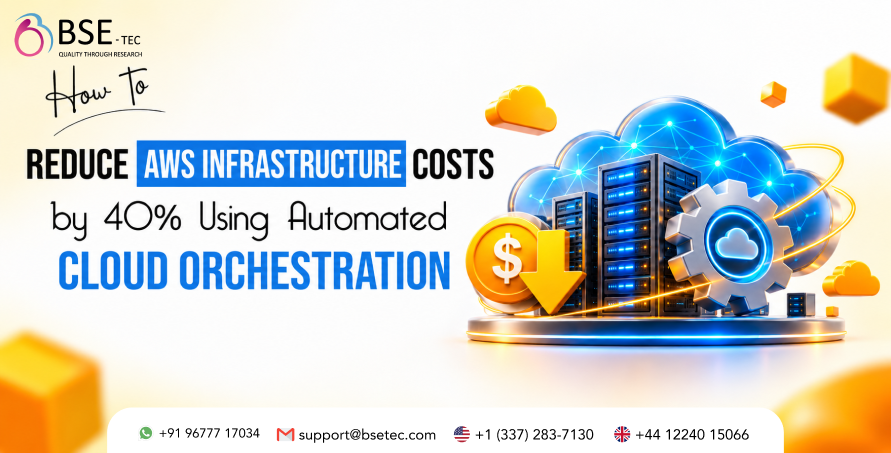
AWS infrastructure costs can rise faster than business growth. As applications attract more users, companies add servers, databases, storage, and containers to maintain performance. However, without proper resource management, these services may continue running even when workloads no longer need them.
At BSEtec, we help businesses build cost-efficient cloud environments through cloud engineering, DevOps, infrastructure automation, and FinOps practices. Our focus is to help organisations scale their applications while keeping infrastructure spending under control.
The solution is not simply switching off expensive resources. Instead, businesses need automated cloud orchestration to monitor workloads, allocate resources intelligently, and reduce unnecessary usage. With the right strategy, organisations can target significant savings, including 40% in suitable environments, without compromising performance.
Why AWS Infrastructure Costs Keep Increasing
An increase in AWS spending does not always mean an increase in business activity. Sometimes, inefficient infrastructure creates unnecessary expenses.
Consider an e-commerce platform that increases its server capacity during a major sale. Once the campaign ends, the same resources may continue running even when customer traffic drops.
Common reasons behind rising AWS bills include:
- Oversized EC2 instances: Businesses pay for more computing capacity than applications regularly require.
- Idle environments: Development and testing servers remain active overnight or during weekends.
- Unused storage: Old snapshots, volumes, and backups increase monthly storage charges.
- Inefficient databases: Database instances consume more resources than regular workloads need.
- Container resource waste: Kubernetes workloads reserve excess CPU and memory.
- Unmonitored data transfer: Network traffic and cross-region communication create unexpected expenses.
Furthermore, these issues become harder to manage across multiple AWS accounts. Therefore, businesses need continuous monitoring and automated cost-control strategies instead of occasional manual reviews.
How Automated Cloud Orchestration Controls Spending
Automated cloud orchestration coordinates infrastructure resources through monitoring tools, predefined policies, and automated workflows.
For example, when application traffic increases, the system can add computing capacity. When demand decreases, it can reduce unnecessary resources.
A typical orchestration setup combines:
- Infrastructure as Code: Terraform and AWS CloudFormation automate infrastructure provisioning.
- Monitoring: Amazon CloudWatch tracks performance and resource usage.
- Auto Scaling: AWS adjusts supported resources according to workload demand.
- Container orchestration: Amazon ECS and EKS manage container workloads.
- Cost monitoring: AWS Cost Explorer and AWS Budgets help identify spending patterns.
- Workflow automation: Scheduled and event-driven processes perform approved actions automatically.
As these components work together, businesses gain better control over infrastructure usage and operational costs.
6 Practical Ways to Reduce AWS Infrastructure Costs
A 40% reduction is a target, not a guaranteed outcome. Actual savings depend on existing infrastructure, application requirements, and workload patterns. However, combining these strategies can create meaningful improvements.
1. Right-Size EC2 Instances
Many businesses choose larger EC2 instances to avoid performance problems. However, these instances may remain underutilised for most of the month.
AWS Compute Optimizer and CloudWatch metrics can identify opportunities to select more suitable instance types.
An automated rightsizing process can review CPU, memory, network activity, and historical usage before recommending changes. Additionally, teams should check peak traffic and application latency to avoid reducing capacity too aggressively.
2. Scale Resources Based on Demand
Application traffic changes throughout the day. Therefore, maintaining maximum capacity at all times can increase unnecessary spending.
AWS Auto Scaling adjusts supported resources according to workload conditions.
For example:
- During high traffic, the platform adds capacity.
- During normal activity, it maintains suitable resources.
- During low demand, it reduces excess capacity.
Furthermore, predictive scaling can help prepare infrastructure for recurring traffic patterns, especially during seasonal campaigns and product launches.
3. Schedule Development and Testing Environments
Development, QA, and staging environments do not always need to operate continuously.
Businesses can automate policies to start approved instances before working hours, stop them after office hours, and reduce capacity during weekends.
AWS Instance Scheduler and custom automation workflows can support these activities.
However, teams must check scheduled jobs and application dependencies before stopping resources. Production systems and critical services should always remain protected.
4. Optimise Cloud Storage
Storage costs grow when businesses retain unnecessary files, snapshots, and backups.
Amazon S3 Lifecycle policies can automatically move eligible objects to suitable storage classes or expire them according to retention rules. Teams should also review unused EBS volumes and outdated snapshots.
A practical storage strategy separates frequently accessed data, infrequently accessed files, archived information, and expired data.
Consequently, businesses can control storage expenses while maintaining access to important information.
5. Improve Kubernetes Resource Allocation
Kubernetes workloads sometimes request more CPU and memory than they actually use. As a result, clusters may require additional nodes without receiving equivalent workload benefits.
Amazon EKS teams can improve utilisation through Horizontal Pod Autoscaler, Cluster Autoscaler, Karpenter, and better resource requests and limits.
Additionally, Spot Instances may reduce costs for workloads that can tolerate interruptions. However, teams must test application behaviour before changing resource allocations.
6. Automate Cost Monitoring
Monthly billing reviews may reveal spending problems only after they have already occurred.
AWS Budgets can trigger alerts when spending approaches configured limits. Meanwhile, AWS Cost Explorer and Cost Optimization Hub help teams review usage patterns and optimisation opportunities.
Businesses can also automate cost anomaly workflows to identify unusual spending, notify responsible teams, and recommend corrective actions. For production changes, approval and monitoring should remain part of the process.
Real-World Case Study: Gordian’s AWS Cost Reduction
Gordian Software, which provides an API for airline ancillary services, experienced infrastructure scalability and pricing challenges with its previous platform-as-a-service provider.
The company moved its infrastructure to AWS and adopted services including Amazon ECS with AWS Fargate, Amazon RDS, and Amazon Aurora for PostgreSQL.
According to AWS’s published case study, Gordian achieved:
- Up to 50% lower total infrastructure costs.
- Up to 40% lower compute costs.
- 30% fewer service issues.
The migration also gave the company greater flexibility to manage normal workloads and traffic spikes.
This case demonstrates how suitable cloud architecture and resource management can improve both cost efficiency and operational performance. However, these results reflect Gordian’s specific environment, not a guaranteed outcome for every business.
2026 Trends Shaping Automated Cloud Cost Optimisation
Cloud cost management is moving beyond monthly billing reviews. Businesses increasingly focus on continuous optimisation and intelligent automation.
AI-Powered FinOps: AI-assisted tools can analyse usage patterns, detect unusual spending, and prioritise cost-saving opportunities. However, teams should validate recommendations before changing critical infrastructure.
Predictive Autoscaling: Instead of responding only to current traffic, predictive approaches use historical patterns to prepare resources for expected demand.
Policy-Driven Automation: Infrastructure as Code and GitOps help teams manage cloud environments through version-controlled configurations, improving consistency and change tracking.
Autonomous FinOps: AI agents can investigate cost anomalies and recommend optimisation actions. Nevertheless, businesses should maintain approval controls, permission limits, and rollback procedures before allowing automation to modify production resources.
AWS also discusses automation and trust in FinOps.
How BSEtec Helps Businesses Build Cost-Efficient Cloud Infrastructure
Reducing AWS expenditure requires more than a cost-monitoring tool. Businesses need a strategy that connects cloud architecture, automation, application performance, and financial visibility.
BSEtec helps organisations build and optimise modern cloud environments through:
- Managed Cloud Services: Cloud setup, monitoring, migration, optimisation, backup, and ongoing support.
- Infrastructure as Code: Automated provisioning and configuration using Terraform, Ansible, and CloudFormation.
- Cloud-Native Development: Microservices, containerisation, Kubernetes, and scalable application architecture.
- DevOps and CI/CD Automation: Automated development, testing, deployment, and infrastructure workflows.
- FinOps and Cost Intelligence: Resource optimisation, cloud spending analysis, and capacity planning.
- AI-Assisted Cloud Operations: Intelligent monitoring, anomaly detection, and operational automation.
Explore BSEtec’s related solutions:
- Managed Cloud Services
- Cloud-Native Development
- Infrastructure as Code
- Resource Optimization
- Automation Services
Conclusion: Make Every AWS Resource Work for Your Business
Reducing AWS infrastructure costs by 40% is not about cutting resources without understanding their purpose. It is about making smarter infrastructure decisions based on actual workload requirements and business priorities.
Automated cloud orchestration helps organisations right-size resources, scale according to demand, optimise storage, and monitor spending continuously. Moreover, combining automation with FinOps and Infrastructure as Code creates better control over cloud expenditure and application performance.
At BSEtec, we combine cloud engineering, DevOps automation, Infrastructure as Code, and intelligent cost optimisation to help businesses build efficient and scalable cloud environments. With the right strategy, your AWS infrastructure can support business growth without allowing unnecessary costs to grow alongside it.